
Why Your Gas Logs Are Turning Black: How Improper Log Placement Causes Soot Buildup
If your gas logs are turning black, your fireplace walls are covered in soot, or your flames look lazy and yellow, there is a good chance your gas log set is not installed correctly.
At Top-Gas Fireplace Services, we frequently receive service calls from homeowners who believe their fireplace is malfunctioning when the real problem is simply incorrect log placement. Even a high-quality gas log set can produce excessive soot if the logs are stacked incorrectly or blocking the burner flame.
In this article, we’ll explain why improper gas log placement causes soot, how to identify the warning signs, and what you can do to restore a clean-burning fireplace.
What Causes Soot on Gas Logs?
Natural gas and propane burn very clean when the correct mixture of fuel and oxygen is present.
When flames hit a log directly or airflow becomes restricted, combustion becomes incomplete. Instead of burning cleanly, carbon particles are produced and deposited throughout the fireplace.
The result is:
- Black soot on the logs
- Blackened fireplace walls
- Dirty glass doors
- Reduced heat output
- Unpleasant odors
- Increased maintenance requirements
In severe cases, excessive soot can permanently stain fireplace components and damage decorative log sets.
Common Gas Log Placement Mistakes
1. Logs Are Blocking The Burner Flame
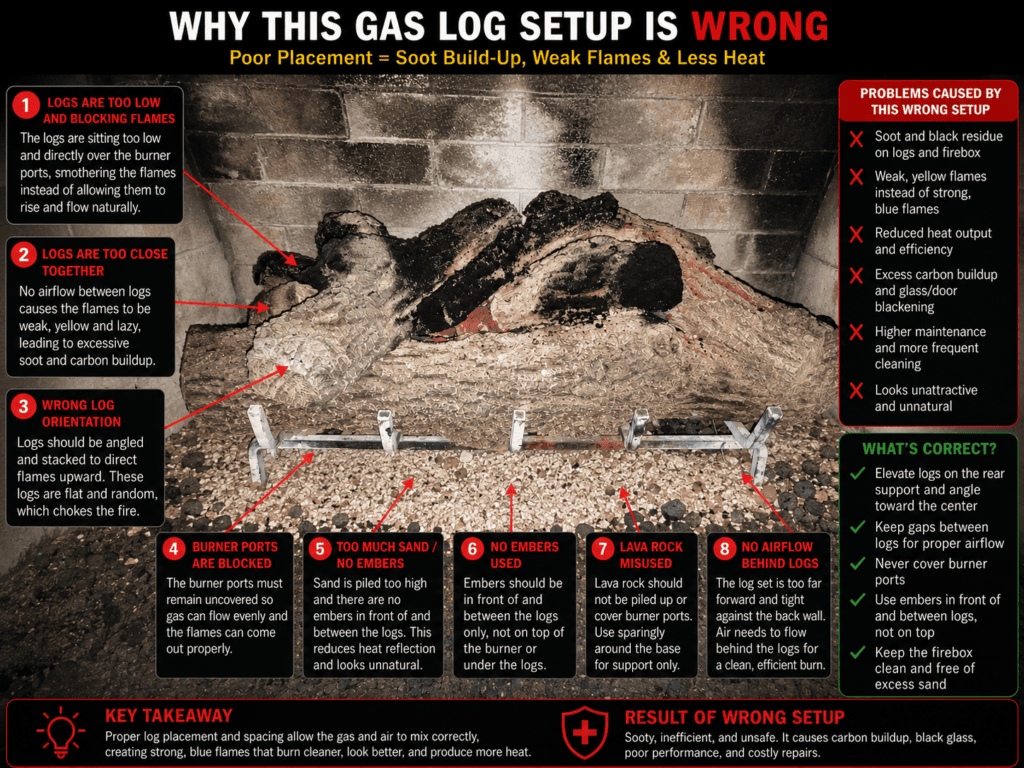
One of the most common problems we see is logs resting directly over the burner ports.
The burner is designed to produce a specific flame pattern. When logs block those flames, the gas cannot mix properly with oxygen.
Instead of producing a clean flame, the burner creates carbon deposits that quickly turn the logs black.
2. Logs Are Stacked Too Close Together
Gas logs should never be piled tightly together.
Flames need room to travel naturally through the log set. When the spacing between logs is eliminated, airflow is restricted and combustion efficiency drops dramatically.
Symptoms include:
- Lazy yellow flames
- Excessive soot
- Darkened logs
- Reduced heat output
Proper spacing allows oxygen to reach the flame and helps maintain a clean burn.
3. Logs Are Installed In The Wrong Position
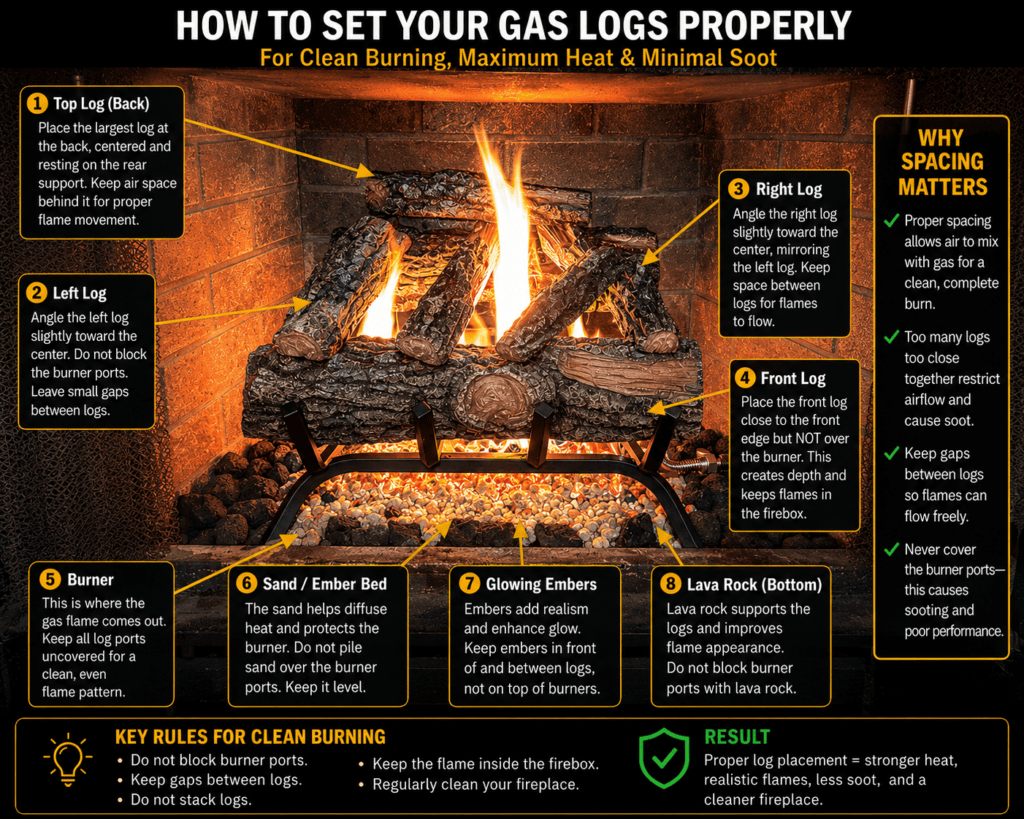
Every gas log set is designed with a specific log placement pattern.
Manufacturers spend considerable time testing flame patterns and airflow before approving a log configuration.
Moving logs from their intended position may:
- Redirect flames improperly
- Cause flames to strike the logs
- Create hot spots
- Produce excessive soot
This is why we always recommend following the original installation diagram provided by the manufacturer.
4. Burner Ports Are Covered
Burner ports must remain visible and unobstructed.
Covering burner ports with logs, sand, lava rock, vermiculite, or other materials interferes with gas flow and can dramatically alter the flame pattern.
When burner ports become blocked, the fireplace often develops:
- Uneven flames
- Delayed ignition
- Carbon buildup
- Sooting issues
The Importance of Proper Airflow
Gas fireplaces depend on airflow just as much as wood-burning fireplaces.
Many homeowners don’t realize that air needs to flow:
- Around the logs
- Between the logs
- Behind the logs
- Through the burner flame
When airflow is restricted, the flame becomes starved for oxygen and begins producing carbon particles.
The black soot commonly found on gas logs is often the direct result of poor airflow caused by improper log placement.
Sand, Embers, and Lava Rock Matter Too
Many vented gas log systems use decorative materials to improve appearance and flame performance.
Sand
Sand helps distribute gas evenly across the burner.
Too much sand can cover burner ports and interfere with combustion.
Glowing Embers
Glowing embers create the realistic appearance of a wood fire.
They should be placed lightly in front of and between the logs—not packed heavily over the burner.
Lava Rock
Lava rock is decorative and should be used around the burner area.
It should never block burner ports or interfere with the flame pattern.
Signs Your Gas Logs Need To Be Repositioned
Your gas logs may be improperly positioned if you notice:
- Black soot on the logs
- Black soot on fireplace walls
- Glass doors turning black
- Large lazy yellow flames
- Flames touching logs continuously
- Uneven flame patterns
- Reduced heat output
- Carbon buildup around the fireplace
If you notice any of these symptoms, stop rearranging the logs yourself and consult the manufacturer’s diagram or a qualified fireplace technician.
The Difference Between a Properly Positioned and Improperly Positioned Gas Log Set
A properly installed gas log set produces:
✔ Clean-burning flames
✔ Minimal soot
✔ Better heat output
✔ Realistic appearance
✔ Longer log life
✔ Lower maintenance requirements
An improperly installed gas log set often results in:
✘ Black logs
✘ Soot-covered fireboxes
✘ Poor flame patterns
✘ Reduced efficiency
✘ Frequent cleaning
✘ Premature log deterioration
Professional Gas Log Service in Houston
If your gas logs are turning black or your fireplace is producing excessive soot, the problem may be as simple as correcting the log placement.
At Top-Gas Fireplace Services, we provide professional gas fireplace repair, gas log installation, fireplace cleaning, and soot troubleshooting throughout Houston, Katy, Cypress, Sugar Land, Spring, The Woodlands, Clear Lake, and surrounding communities.
Our technicians can inspect your fireplace, verify the proper log arrangement, adjust the burner system, and restore safe, clean operation.
Need Gas Fireplace Repair?
Contact Top-Gas Fireplace Services today for professional gas fireplace repair and gas log service in Houston. We’ll identify the cause of soot buildup and get your fireplace burning cleanly again.